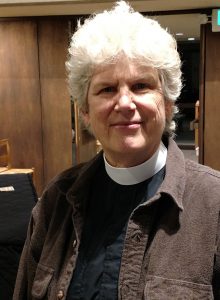
The Rev. Janet Campbell Priest in Charge, Christ Episcopal Church
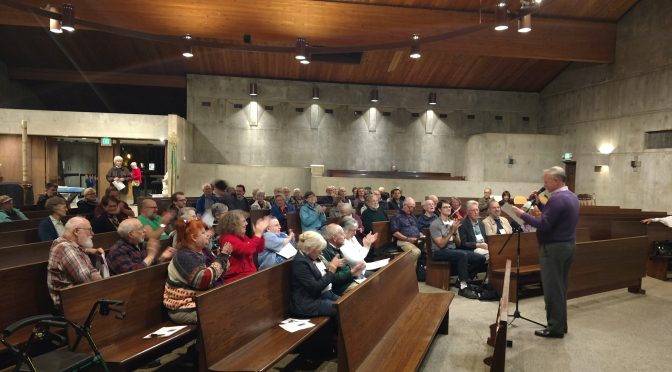
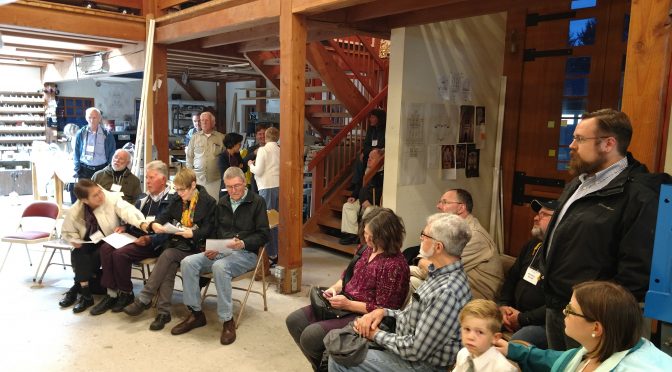
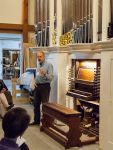
With a large audience in attendance, composed of members of the Tacoma AGO and Christ Episcopal Church, Dr. Samuel Torvend, Associate Priest for Adult Formation and Dr. Mark Brombaugh, co-Director of Music, presented a program entitled No Greater Art: A Revolutionary Change in Congregational Singing.
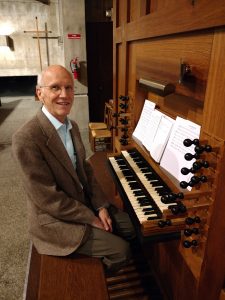
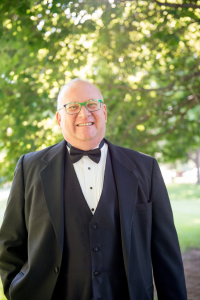
Dr. Mark Brombaugh
Using musical illustrations of congregational singing ably accompanied by Dr. Brombaugh, Dr. Torvend described the transition from a world in which almost all aspects of liturgy were reserved for clergy, to one in which the average congregant had a right to participate and to express opinions.
In the sixteenth century, public singing was popular and widespread–everywhere except the church, where the congregation had a limited role, if any. The participation in worship services was passive. Under the practice of ocular theory, it was felt to be sufficient to gaze upon events in order to derive benefit.
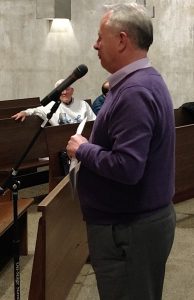
Dr. Samuel Torvend
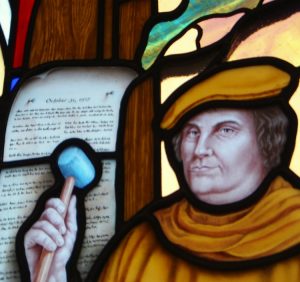
Martin Luther was born into this environment of working class parents. He played lute, sang in the streets for cash, and in church choirs, eventually becoming a friar. He became active politically, criticizing the religious teachings that were part of his daily life. In the course of these changes, Martin Luther began to espouse democratic evolution in the church. He proposed establishing tax-funded public schools with equal access for girls and boys. In 1524, Luther published the first German hymnal.
Luther considered singing to be the most democratic of art forms. He translated many well known Latin texts into German, keeping chant melodies in many cases, but using many musical genres to advance his ideas of reform. Martin Luther approached reform differently from others in that he wished to blend new music into the existing musical heritage, but also to expand his vision to include visual arts and architecture. His goals may have included the truth, but also necessarily included a need to distinguish his religion of the people from its competitors.
“If Martin Luther were alive today, he would be a remarkable user of the Internet.” –– Samuel Torvend
Luther’s reforms were not limited to the Mass. He had a deep investment in the Psalms, wrote his own version of the Daily Office, made changes in the Mass as well, but did not abandon it. He wrote hymns that could be used in every part of his Catechism. Luther defended his actions as being those of a “conservator” rather than a reformer.
Luther insisted on a sung liturgy, emphasizing the importance of song in church assemblies. We have an opportunity and responsibility today to promote singing–in churches, synagogues, cathedrals, and universities. The Lutheran tradition would have us continue to expand the role of singing, with expanded instrumentation and the inclusion of international music.
The handout (minus the hymns) is reproduced below.
Our October program, co-hosted by Father Samuel Torvend and Tacoma AGO member Dr. Mark Brombaugh, will focus on hymns of the Reformation. In this AGO gathering, participants will explore the revolutionary changes in church music set in motion by Martin Luther, sing a number of Luther’s hymns, and discuss current trends that suppress and support the assembly’s voice.
Fr. Samuel Torvend is Associate Priest for Adult Formation at Christ Episcopal Church and Professor of Religion at Pacific Lutheran University. Dr. Mark Brombaugh is Co-Director of Music at Christ Church. Together they will lead this event that marks the 500th anniversary of the Reformation.
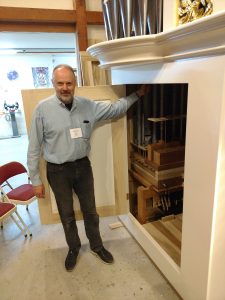
Paul Fritts demonstrates the organ’s mechanical action
Paul Fritts, founder of Paul Fritts & Company, talks about a “warm, live room” in describing First Presbyterian Church in Bloomington, IN, the destination of Opus 41, a large 2 manual organ undergoing final touches in the Fritts Organ Shop in Parkland, Washington. While the room itself is inviting, and a good acoustical home for an organ, the climate is not. The very cold winters, and hot, humid summers have the potential to make the wooden organ parts swell and contract, and even crack. To reduce this effect, the wood used in the organ is cooked–heat treated in a vacuum for varying periods, depending on its intended use, greatly reducing the potential for being altered or damaged by a changing environment.
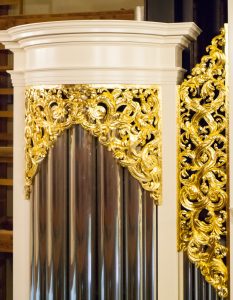
Hand carved pipe shades with gold leaf
The aesthetics of the organ are also important, and carefully considered with respect to how the organ will appear when it takes its place at the front of the church. The width of the pedal towers, for example, is compared to the space in between them, and those ratios compared to architectural ratios found in the church. The pipe shades are carefully and intricately carved, and have been painted with gold leaf to enhance the visibility of the detail.
Three Members Perform Varied Repertoire
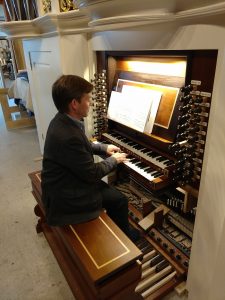
Paul Tegels performs during members recital
On Monday, September 18, the Tacoma Chapter of the AGO met to see the almost-completed organ and to hear a members’ recital. Paul Tegels, organist at Pacific Lutheran University, opened the musical portion of the program with an echo fantasia of J. P. Sweelinck, and continued, with Haydn pieces for a musical clock, and pieces by Franck and Krebs.
Member Curt Sather performs
Curt Sather, organist at St. John’s Episcopal Church in Olympia, added music of two Bachs–chorales of J. S. Bach and a movement from a C.P.E. Bach sonata. Demonstrating the versatility of the organ (and the organist) Curt included pieces from A Quaker Reader by Ned Rorem (born 1926).
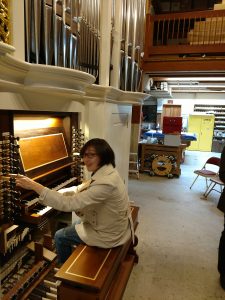
Member Naomi Shiga selects registration prior to performing
Naomi Shiga, organist at St. Andrews Episcopal Church in Tacoma, and current dean of our chapter, introduced the program, and concluded the musical portion with Bach Allein Gott and Fugue in C Major.
“This chapter is so fortunate to have so many talented organists and organ builders. It’s unusual.”
–David Dahl, Organist Emeritus, Pacific Lutheran University
The Chapter is indebted to Paul Fritts for graciously hosting this program and providing an introductory talk. Many thanks also to Karen Bredberg for providing refreshments for this opening program.
Additional Photographs
Members Satya Jaech and David Dahl inspect the organ
Member Tom Clark and potential member Sebastian perform duet
Back view of the organ showing tracker action
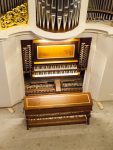
Front view of organ
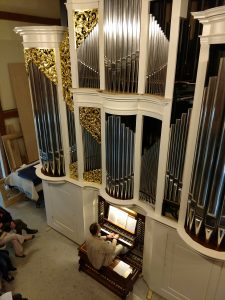
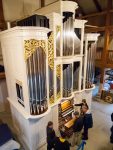
Aerial view of organ
Paul Fritts discussing construction of the organ
Recital Program
The recital program is attached below. Note that page 2 includes a stop list, with indications of which stops are currently playable.
National Lutheran Choir to Commemorate 500th anniversary of the Protestant Reformation through music with fall concert tour to Pacific Northwest
From September 28 through October 1, the National Lutheran Choir will embark on a concert tour to select cities in Washington and Oregon. Commemorating the worldwide anniversary of 500 years since the Protestant Reformation, the Choir will present two separate programs of sacred choral music and beloved hymns. Performance venues include Pacific Lutheran University’s Lagerquist Hall (Tacoma, WA), Saint Mark’s Episcopal Cathedral (Seattle, WA), Trinity Episcopal Cathedral (Portland, OR), and St. Paul’s Episcopal Church (Salem, OR).
Una Sancta, a concert program aimed at illuminating Luther’s understanding of the work of the Holy Spirit—“it calls, gathers, enlightens, and sanctifies the whole Christian church…”—will be performed in Tacoma, WA in conjunction with Pacific Lutheran University’s “Re-Forming” anniversary series, as well as in Salem, OR at St. Paul’s Episcopal Church Music Series. Program highlights include J.S. Bach’s motet Der Geist hilft, the “Kyrie” from G.P. da Palestrina’s Missa Papae Marcelli, “Agnus Dei” from Frank Martin’s Mass for Double Choir, and choral music from renowned composers Eriks Ešenvalds, Kenneth Jennings, Charles Marie Widor, Kim André Arnesen, and Moses Hogan.
This performance will take place at Pacific Lutheran University on September 28, 2017. More information is available in the Tacoma AGO calendar.
Jesus Christ: Yesterday, Today, Forever is an evening of song commemorating the 500th anniversary of the Reformation featuring the National Lutheran Choir leading a massed choir of local singers. Presented in the tremendous acoustics of the Episcopal Cathedrals in Seattle and Portland, this program features a unique assembly of hymns and choral repertoire woven together to celebrate the rich treasury of music expressing the journey of the ever-reforming Church. Highlights include Martin Luther’s famous hymn tune EIN FESTE BURG, a multi-choir setting of Psalm 136 by Heinrich Schütz—commissioned for the 100th anniversary of the Reformation by the Lutheran Church in Germany—and hymns and repertoire from Korea, France, South Africa, Norway, Hungary, Latvia, and the United States.
This performance will take place on September 29, 2017 at St. Mark’s Cathedral. More information is available in the Tacoma AGO Calendar.
About the National Lutheran Choir
Dr. David Cherwien
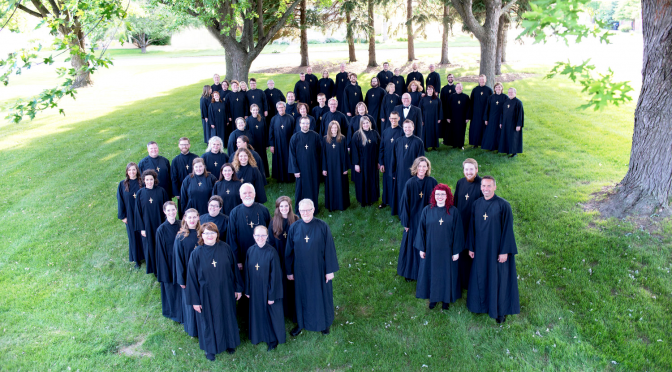
The National Lutheran Choir is a 64-member vocal ensemble based in the Twin Cities of Minneapolis and St. Paul, MN. Under the direction of nationally known conductor, composer and organist Dr. David Cherwien and formerly at First Lutheran Richmond Beach in Seattle, the National Lutheran Choir’s artistry is rooted in its mission to strengthen, renew and preserve the heritage of sacred choral music through the highest standards of performance and literature.
Founded in 1986, the National Lutheran Choir sings a sacred and spiritual story rooted in the Lutheran choral tradition. In addition to concertizing, the National Lutheran Choir enjoys frequent broadcasts on public radio and curates a YouTube channel with thousands of views of selected performances and concert streams.
With 24 registered participants, members of the Tacoma AGO Chapter entertained and educated prospective organists in a 3-hour, 2-venue Pizza, Pedals, and Pipes event.
At the Fritts Shop
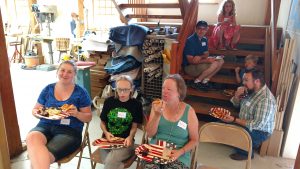
The event began at the Paul Fritts organ shop in Parkland, with introductions, pizza, drinks, and homemade brownies.
Group enjoys pizza and browniesPaul Fritts introduces Opus 41
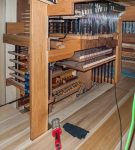
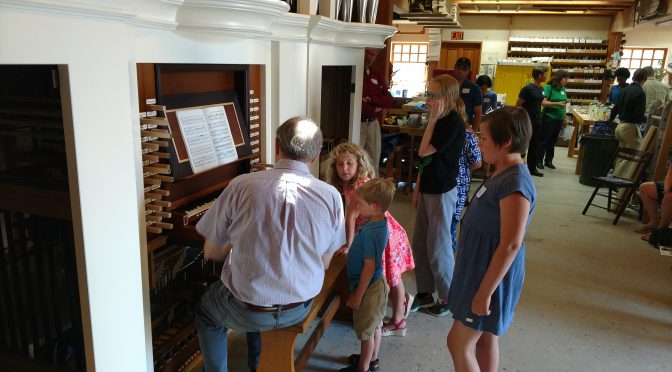
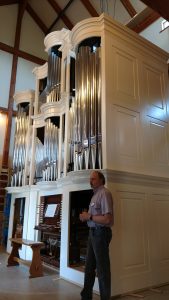
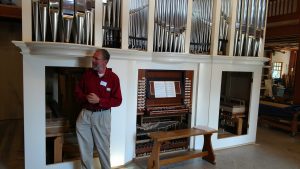
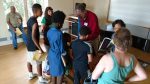
Paul Fritts introduced Opus 41, a work in progress slated for delivery this Fall to the First Presbyterian Church in Bloomington, Indiana. Surrounded by engaged piano students, Paul explained the construction process, mechanical action, and demonstrated how a pipe works.
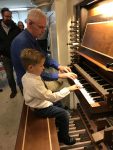
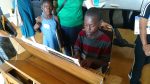
Students got to observe the movement of the trackers in response to keys being depressed. Several students tried the keyboard as Paul explained the difference between the feel of a piano and the feel of a mechanical action organ.
Paul Fritts explains pipe making
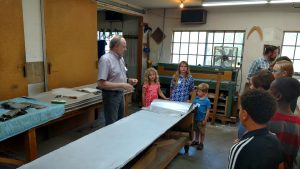
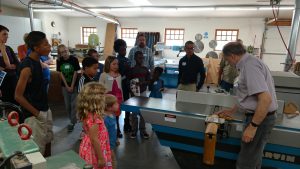
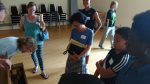
Paul then led the group on a tour of the shop, starting with pipe making. Students got to see lead sheets on a sand table, and learned about how the metal is melted and formed into pipes. The group proceeded into the woodworking shop to learn how raw wood is transformed into an organ case.
Woodworking explained
Following the tour, Paul Tegels demonstrated the organ, showing how pipes of different lengths make sounds in different octaves, using musical examples. At this stage in its construction, only a few complete stops are working, but it was enough to get the idea across.
Over the next several weeks, the organ will be completed, but still not in its final form. It will be disassembled, put onto a moving van, then reassembled in the church that is to be its home. At that time, the organ will be voiced and tuned, each pipe being optimized for the acoustical environment of First Presbyterian Church.
Paul Tegels discusses pipe length and pitch prior to performing
At Lagerquist Hall
Paul Tegels discusses acoustics and placement of the organ in Lagerquist Hall
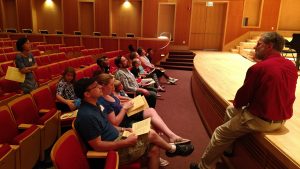
Arriving at Lagerquist Hall, the group received an introduction to the Gottfried and Mary Fuchs Organ, a large 3-manual mechanical action organ built by the Fritts Company in 1998. The introduction began with a description of Lagerquist Hall, with its variable acoustical environment. and continued with the layout of the organ, including its several divisions.
Paul Tegels then opened a brief recital with Toccata in D Minor of J. S. Bach–sure to appeal to aspiring organists! The recital continued with pieces chosen (or written) for the occasion, including Cheryl Drewes and Curt Sather playing transcriptions of pieces known to all teenagers–themes from Harry Potter and Star Wars. Paul Tegels then concluded the recital with a very exciting rendition of Grand Choeur Dialogue of Eugène Gigout.
Students Play Two Organs
The group split into two smaller groups, led by Satya Jaech and Cheryl Drewes, so that each could have some hands-on time on two different organs.
Curt Sather demonstrating the large Fritts organ in Lagerquist Hall
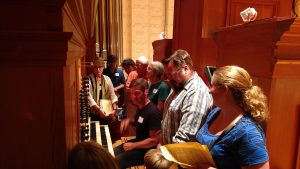
Curt Sather gave a brief introduction to the key desk in the Lagerquist organ gallery, and then assisted each student who wanted to play, providing registration assistance and even accompaniments to their pieces.
The Brombaugh positiv organ
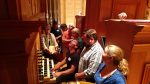
Paul Tegels made a small portable organ available in a classroom. This organ has a single keyboard, with three stops, and no pedal board. It was built by John Brombaugh and Co in 1979. The three stops are an 8’ Gedeckt (wood), 4’ Flute (wood), 2’ Principal (metal). It has a transposing keyboard, so it can play at A=440 Hz, or A=415 Hz. It has elaborate carvings, and has traveled to Europe and China. Such organs are typically used for playing continuo in musical groups or choral performances, but today it provided an excellent transition for piano students playing organ for the first time.
Event participant plays the Brombaugh positiv organ
Two World Premiere Transcriptions
It should be noted and recognized that two of our chapter members transcribed pieces for this occasion in order to demonstrate organ literature in a way that would appeal to a wide audience.
Cheryl Drewes spent several weeks working on a transcription of Hedwig’s Theme from Harry Potter and the Sorcerer’s Stone, resulting in a work not unlike some of the standard symphonic organ works. Concerning her work, Cheryl says ” It is always important to make the orchestral score into a true organ piece; keyboard logistics, registration and style all have to be considered. As an orchestral piece, the tempo is furiously fast- string players can do that. As an organ piece, the tempo is a bit slower, about a Baroque allegro, which works fine because that tempo is idiomatic to the organ. I was lucky that Williams’ orchestration fit in the hands and feet just fine. It felt like a chorale followed by a trio sonata followed by a fantasia- a Buxtehude Preludium and ViernePiècesdefantaisie mash-up.”
Curt Sather chose a medley of themes from Star Wars, including the film’s opening theme, Princes Leia’s theme, and the Darth Vader theme. and filled Lagerquist with images of Luke Skywalker and Obi-Wan Kenobi. Curt was playing from a lead sheet he created–a musical blueprint to be filled in while playing. The lead sheet describes very basic melody and indications of harmony. The musical voices themselves are improvised by the player during the performance. There is nothing like a 32-foot reed to send Darth Vader scurrying.
Photo Album
This album contains additional photographs from the event.
Acknowledgments
This event would not have been possible without the interest and enthusiasm of a number of members of our chapter. In particular, we acknowledge
Paul Fritts for his generosity and hospitality, opening his shop on a Saturday, giving a talk and a tour, and answering lots of questions.
The staff of the Fritts Organ Shop for working extra hours to get the organ playable for this event, and especially to Stevie Jett for helping with pizza baking and other logistics.
Paul Tegels, University Organist at pacific Lutheran University, for hosting the Lagerquist portion of the day, making two organs available, playing at both venues, and helping students play their pieces on a continuo organ.
Cheryl Drewes for many hours transcribing and performing a piece that the participants would recognize and enjoy, for acting as host, and patiently answering questions.
Curt Sather for his own transcription and performance of a difficult piece, for hosting, answering questions, and providing accompaniment and registration as students played their pieces.
Satya Jaech for acting as host, helping to plan the content of the instructional sessions, obtaining booklets for each student to take home, and being a moving force in the planning.
Karen Bredberg for participating in event planning, and planning and preparing the food.
Sandy Tietjen for participating in event planning, and planning and preparing the food.
Don Rumsfeld for participation in the planning and preparing a color handout for each participant.
David Dahl for participating in the planning, and for providing guidance and encouragement to the group.
Una Hwang, Sub-dean and Program Chair, for the vision, leadership, and tenacity to make this event work, and for recognizing the importance of community outreach and education.