Category Archives: Articles

Fritts Organ at Notre Dame Completed

Paul Fritts
Paul Fritts

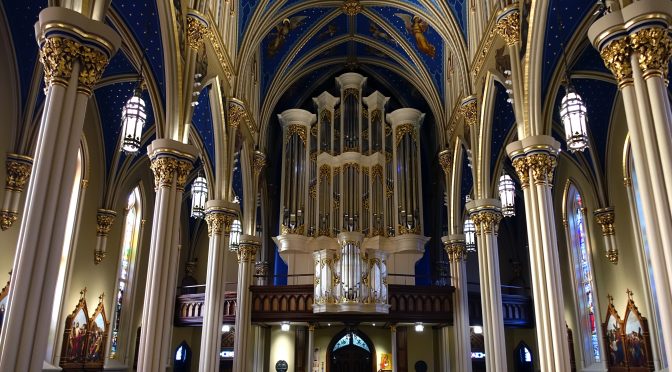
The organ workshop of Paul Fritts & Co. in Parkland WA has recently completed the delivery and installation of Opus 37 for the Basilica of the Sacred Heart on the campus of the University of Notre Dame in South Bend, IN.

The organ is the firm’s largest to date, with 69 stops and 4 manuals. There are some 5,164 pipes including a full-length 32’ Posaune in the Pedal.

The organ has numerous firsts for the company:
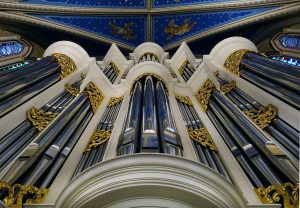
Paul Fritts Opus 37 at Notre Dame

The majority of the pipework for the organ is made from tin/lead alloys that have been cast on sand instead of the previous method of casting the metal sheets on top of a cloth-covered slab of stone. The sand casting is a more ancient method of preparing the metal that causes the molten metal to cool much more quickly than on the stone slab. This rapid cooling causes the crystals which form in the metal as it solidifies to be much smaller than when the metal is allowed to cool more slowly. This crystal structure imparts a subtle but important character to the metal that seems to promote elegant pipe speech and a colorful sustained sound.

It is the first 4-manual organ built by the Fritts workshop.
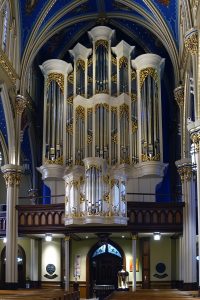
Paul Fritts Opus 37 at Notre Dame

It is the first organ by the company to incorporate both German and French reed stops on the same divisions. French reeds at 16’ and 8’ pitch in the Pedal, at 8’ and 4’ pitch in the Great and a Cromorne 8’ in the Rückpositive join the Cavaille-Coll style Hautbois 8’ in the Swell to add substantially to the ability of the organ to play French literature.

There is also a Renaissance-style Trompet 8’ in the Swell which is patterned after those built by the great North German Scherer family of organ builders.

The organ makes use of “thermally-modified” lumber in the playing action (keyboards, backfall levers, couplers, etc.) as well as in the windchests for sliders and toeboards. This material is the result of a new way of treating wood that has been cured at a high temperature in kilns where the oxygen has been removed to prevent the wood from burning. The high temperatures cause the cells of the wood to seal off effectively, making the wood resistant to absorbing or giving off moisture and thus remaining very stable dimensionally. The result is that dimensionally-critical parts of the organ remain stable throughout seasonal swings in the humidity level.

The organ is also the first to use carbon fiber rods as trackers throughout the instrument. These, too, are entirely impervious to humidity changes,  which is especially important in a large instrument with very long tracker runs. An added benefit is their lower mass.
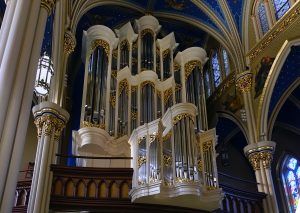
Paul Fritts Opus 37 at Notre Dame

As in all of the larger Fritts organs, the Notre Dame instrument has “dual” stop action. The stop action is first and foremost mechanical with the drawknobs being physically attached to the windchest sliders. Electric solenoids can move the stops when thumb pistons or toe studs are depressed. These solenoids are controlled by a sophisticated computer system that has 999 levels of memory, meaning that all of the pistons and toe studs can be set 999 different times. Additionally, this is the first use of so-called “intelligent” solenoids that incorporate optical sensors to monitor the movement of the solenoid during the actual motion. If the solenoid is moving too slowly, the computer can send additional amperage to speed up the movement. It can also slow down a solenoid that is moving too quickly. The motion of the solenoid is also monitored to reduce the current as the slider reaches the end of its travel to quiet the system.

The organ was set up in the Basilica and voiced and tuned very quickly and efficiently. The entire process, from the unloading of the trucks to the tuning of the final pipe, required just 81 days. Preparation of the organ in the workshop along with the shop voicing of the flue pipes, and especially the careful voicing of the reed pipes on the actual windchests in the organ in the shop, contributed substantially to the savings of time during the installation.

Both the visual and sonic impacts of the organ in the Basilica have exceeded the expectations of all involved in the project. It is hoped that the organ will serve as an inspiration for both worship in the Basilica and for the organ students and other performers for many generations to come.
Bruce Shull
Bruce Shull

Please stop by the Basilica to see and hear the new instrument if you are in the South Bend area.

Bruce Shull
Erik McLeod
Erik McLeod

Listen to Erik McLeod improvising on some of the “bigger sounds” of the Notre Dame organ.
UW Reger Symposium

The University of Washington Department of Music and Seattle’s St. Mark’s Cathedral present a symposium celebrating the organ music of German composer Max Reger on November 11 and 12 at the School of Music, with affiliated events at Seattle’s St. Mark’s Cathedral.  The series includes an organ recital, four lectures, and a recital of chamber music.

The brochure is attached below and available for download.

1111_RegerPRNT


St. Andrew’s Organ Series to Open with Christa Rakich

The 2016-2017 concert series at St. Andrew’s Episcopal Church opens on October 28 at 7:00 PM with Christa Rakich, director of music at  The Catholic Church of St. Mark the Evangelist in West Hartford, Ct.  She will be playing Bach on organ and harpsichord, including part of the Goldberg Variations.

A prizewinner at international organ competitions (notably Bruges 1976), Rakich has received particular acclaim for her interpretations of the music of J.S. Bach. With keyboardist Peter Sykes, she performed a complete cycle of Bach’s keyboard works in a series of 34 concerts from 2003 to 2005 aptly named “Tuesdays with Sebastian.” Christa Rakich is a founding member of Ensemble Duemila, and performs regularly with the Fanfare Consort. As a soloist, she performs under the aegis of Independent Concert Artists.

The 2016-2017 St. Andrew’s Organ Concert Series poster is attached below.  It can also be downloaded here.  Additional details on the remaining concerts can be found in the Tacoma AGO calendar.

st-andrews-ocs-flyer-2016-17

October focus: Clavier-Übung III

Jonathan Ryan presenting the October program

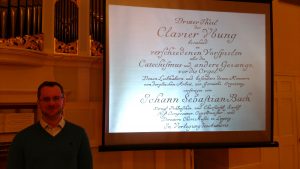
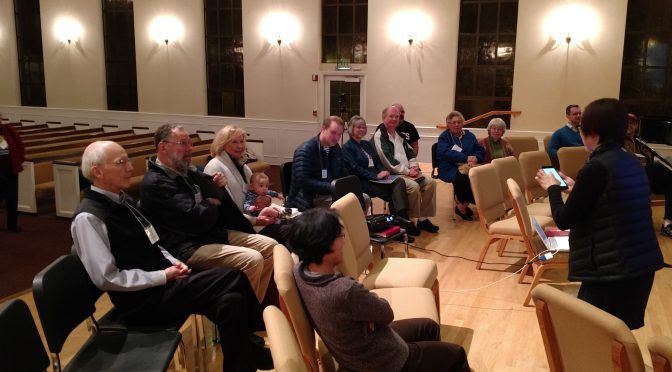
Our October program was a double feature.  On Sunday, October 09, Tacoma AGO members heard Jonathan Ryan perform Bach’s Clavier-Übung III as part of the Richard D. Moe organ recital series at Pacific Lutheran University.  Then, on Monday, Mr. Ryan spoke on the Clavier-Übung as the program of our October meeting in Kilworth Chapel at the University of Puget Sound.

The program was in two parts, the first being a discussion of the four parts of Bach’s Clavier-Übung, setting the historical context with references to contemporary documents and musical examples.  Mr. Ryan presented musical arguments to support the theory that the Clavier-Übung part III meets the definition of an organ mass.

The second part of the program focused on performance practice, including tempo, registration, and ornamentation.  Mr. Ryan made a point that Bach ‘s use of registration was unusual and controversial in his time, and presented historical references to support unconventional registration.

The handout is attached to this article and available for download.

20161010-ago-ryan-handout

October program: Bach’s “Clavierübung III”

Our October program is a double feature!  On October 9, at 3:00 PM in Lagerquist Hall, Jonathan Ryan will play Part III of Bach’s Clavierübung.    Because this PLU event is partially sponsored by the AGO, Tacoma AGO members who are under age 55 will get a discounted admission price of $10.  Members who are age 55 or greater already qualify for the PLU Senior Citizen rate of $10.

The following day, on October 10, Mr. Ryan will discuss this work at Kilworth Chapel at 7:30 PM.  His presentation will focus on the work’s  context, genesis, and symbolism.  He will address structure, and style within the movements, with an emphasis on practical application and performance.

Mr. Ryan has the rare distinction of holding six First Prize awards from major international and national organ competitions.  He most notably entered the international spotlight when awarded First Prize in the 2009 Jordan II International Organ Competition, one of the most substantial First Prize awards of any organ competition at the time. He was additionally awarded the only auxiliary prize at the Jordan Competition, the LeTourneau Concerto Prize, given for the best performance of a newly commissioned work for organ and percussion ensemble.  Additional First Prize awards include the 2006 Arthur Poister National Organ Competition, the 2006 John Rodland Scholarship Competition, the 2004 Albert Schweitzer National Organ Competition (Young Professional Division), and the 2003 Augustana Arts-Reuter National Organ Competition.